
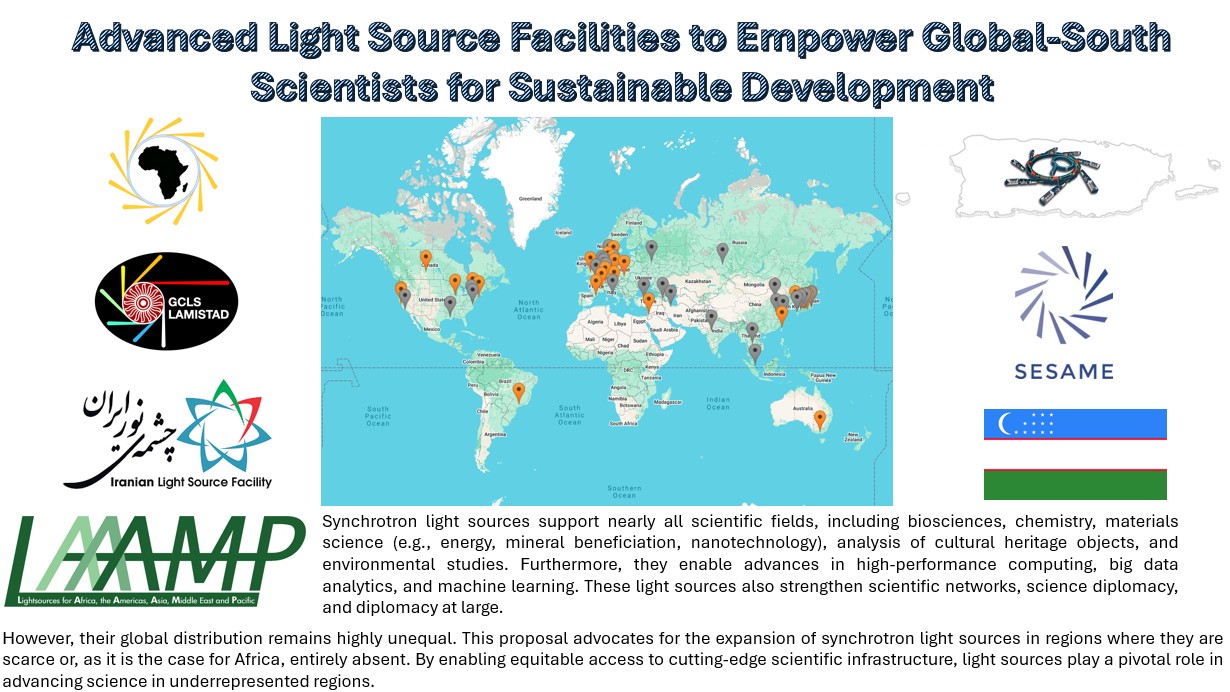

These remarks reflect discussions in the Greater Caribbean Light Source Initiative (GCLSI), but are presented by me in my personal capacity, and not as Chair of the GCLSI Executive Committee or in representation of its alliance with AfLS, now AAS-AfLS, as we learned from Simon Connell, and the Iran, Uzbekistan, and Puerto Rico projects, which, under the LAAAMP umbrella, have been recognized by UNESCO as a Project of the Decade of Science for Sustainable Development.
The idea of a beamline at SESAME dedicated to African scientists is great. If such an initiative is implemented, it could also have an interregional role, benefiting scientists across different regions and fostering collaboration among research communities in Africa and beyond. However, we must recognize that it would remain just a drop in the ocean, given the scale of global scientific infrastructure. Worldwide, the number of beamlines can be estimated at around 2,000, concentrated in the Global North. The South, by contrast, faces a serious deficit of such advanced infrastructure and cannot rely only on marginal access to facilities located far away.
We are all familiar with the global map of synchrotrons. There are none in Africa, and only one in Latin America, namely SIRIUS in Brazil. This stark disparity highlights the North–South divide in big science infrastructure more clearly than any other metric. Access to cutting-edge experimental facilities is not merely a matter of convenience; it is essential for developing scientific capabilities, training highly qualified personnel, and enabling research that can directly address regional challenges, from health and agriculture to energy and environmental sustainability. This requires substantial investment in local infrastructure, without which the scientific and technological potential of the Global South will continue to lag behind, and inequalities in knowledge production and innovation capacity will persist.
Of course, intermediate measures can be useful and should not be dismissed. Recently, for the first time in our region, GCLSI organized a training activity in Colombia in collaboration with a local university. It provided hands-on experience and advanced training to young scientists, enabling them to work more effectively with international collaborators and prepare for the use of synchrotron facilities in the future. Yet, while such initiatives are important, they cannot substitute for the presence of major scientific infrastructure in our regions. Neither access to a few beamlines abroad nor occasional training events can fully compensate for the systemic benefits of locally available, state-of-the-art facilities. To close the gap, decisive action and long-term planning are required—and they are urgently needed.
The five projects I referred to, currently under discussion in Africa, Asia, and Latin America, are aligned with this vision. However, I must acknowledge that progress since our network was launched last year has been limited to a declaration, issued approximately ten months ago at an event held at ICTP in Trieste, that expressed commitment to fostering a network of light sources for the Global South. Regrettably, this declaration has not yet been followed by substantial concrete actions. While this is partly due to broader challenges affecting multilateral cooperation today, it also reflects the complexity of coordinating international and regional stakeholders to move from vision to implementation. Nevertheless, despite the crisis in multilateralism, we must continue to pursue such a long-term, visionary program, guided by a clear understanding of the scientific, economic, and societal benefits that these investments can deliver.
Several concrete actions can help advance this agenda:
- Joint training. The creation and strengthening of the global users’ community is essential. ICTP organizes such training annually, providing young researchers with the knowledge and skills needed to operate and exploit advanced facilities. However, training programs must be developed worldwide, with explicit mechanisms for interregional participation. They must include training at beamlines, for which the goal of a few hundred users per year cannot be enough. One of the main outcomes of the recent school we organized in Colombia, which brought together students and early-career scientists from multiple countries, was that over the next 12 months we aim to organize a similar school in Mexico and at least one more in Colombia, where it has been proposed that the Distrital University program become a recurring event. These initiatives rely heavily on strong linkages with universities and advanced education programs. We also welcome encouraging signals from the Dominican Republic, where a new PhD program in relevant fields is being launched in the coming days, which could become a key regional hub for training.
- Promotion of small accelerators. Beyond large synchrotrons, smaller accelerator facilities can play a critical role in building local expertise and demonstrating the economic and social returns of investment in big science. Their applications are diverse, ranging from medical imaging and materials science to industrial testing and environmental monitoring. By showing tangible benefits in multiple sectors, these facilities can attract broader support from governments, industry, and international partners, thereby creating a foundation for the eventual establishment of larger infrastructure, even if, to some extent, they may be contradictory to the main goal.
- Regional cooperation. This is particularly important for Africa and the Greater Caribbean projects. Seven years have passed since Ghana’s first official support for the African project, which still relies on a small number of participating countries. Expanding the network requires not only political commitment but also effective coordination among existing participants and engagement with additional nations. Encouragingly, in Latin America, interest has been expressed by the Brazilian government, and there are early signs of governmental interest in the Dominican Republic. Strengthening regional cooperation can help pool resources, harmonize training programs, and ensure that investments in infrastructure produce benefits that extend beyond national borders.
- Global program with international support. A coherent, long-term program for building synchrotron infrastructure in the Global South can only be realized with broad international backing. UNESCO has already played a proactive role in the proposal for a beamline at SESAME, and I hope it will continue to demonstrate similar leadership in supporting the creation of a network of light sources that serve multiple regions. This kind of high-level international support is essential to mobilize resources, coordinate technical expertise, and maintain political commitment over the many years required to establish and operate these facilities.
- Engagement with the UN system. Synchrotrons should not be viewed merely as scientific tools; they have far-reaching applications in health, agriculture, environmental monitoring, and industrial development. Accordingly, their establishment in the Global South should be recognized as a priority by multiple UN agencies, including FAO, WHO, and UNIDO, with coordination and promotion through UNDP. This broader engagement can help integrate scientific infrastructure development with wider development goals and sustainable development agendas. While it would be shortsighted to rely solely on UNESCO, UNESCO can lead an interagency process.
- Engagement from the UN system. UNESCO played a major proactive role in the creation of SESAME. Similar support for a Global South Network is desirable. In my view, it should be clear that an interregional project provides a stronger case for support by an international organization than a regional one. SESAME resulted from joint action between UNESCO, CERN, and SLAC. The political meaning of an initiative for the Middle East was obvious, but the case for Africa and Latin America should trigger similar cooperation.
- International scientific cooperation. Existing synchrotrons are ready to cooperate. Visits by politicians can be instrumental in spreading understanding of the potential of this tool. A few months ago, there was an unsuccessful attempt to take advantage of an activity at UNESCO Headquarters to visit SOLEIL. Probably a dedicated synchrotron conference could include it again in its program.
- International political cooperation. Additional sources of support should also be explored. These include European Union programs, individual national initiatives—for example, the Italian Mattei Plan for Africa—and existing Ibero-American cooperation programs. By diversifying funding and partnership channels, the network of synchrotron facilities in the Global South can be developed in a more resilient and sustainable way, ensuring that investments produce maximal scientific, social, and economic impact.
In conclusion, establishing major scientific infrastructure in the Global South is not only a matter of fairness or equity—it is a strategic investment in knowledge, capacity, and development. Intermediate actions, such as training programs or access to a limited number of beamlines abroad, are useful but insufficient. Only through long-term planning, regional cooperation, and broad international support can we create the conditions for transformative scientific capacity, which will benefit not only the regions directly involved but the global scientific community as a whole. The time to act is now, and the vision must be ambitious, inclusive, and forward-looking.